
Emigration: Arrival Ports in North America in the Settlement Years

Updated: Jan 17
By Shaune Jonasson
Some ancestral stories of the crossings were captured in family diaries, a real treasure to possess today. Despite any trepidation to leave their homes and families, most believed in a better life ahead. They were resolute. We are here as a testament to their hope.
When our Icelandic ancestors left their homeland bound for North America, many unknowns lay ahead of them. The reasons for emigrating are many and we’ve heard or read the accounts of life in Iceland before they departed. This article will include some ports of arrival used by our ancestors as they made their way to a new life.

To emigrate is an enormous decision. Government agents gushed with reasons to leave their home and life in Iceland. In the West, there was a vast amount of land to be farmed and plenty of other work opportunities. The governments needed population growth, and immigration would bring labourers and farmers. With trust in these agents, the shipping companies, and of their own desires, our ancestors stepped on the boat in Iceland. Their journey had begun.
The crossing to North America took an extensive amount of time, certainly far more than we could relate to with our current international travel environment. I am curious if our ancestors knew how long it would take. Would they have left if they knew it would take weeks, sometimes months before they would step onto their new homeland? And sadly, some of them didn’t make it at all.
The arrival port was the first introduction they had to their new homeland.
ICELANDIC ROOTS EMIGRATION TEAM
Icelandic Roots has an Emigration Team, a group of volunteers trying to identify and document each emigrant. Their task is a huge undertaking. This plethora of information has been detailed in the IR database. Here you can research your family and learn about their crossing, the ships and their manifests, and ports of arrival.
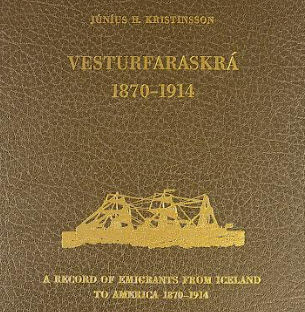
Vesturfaraskrá, a book published in 1983, indexes over 14,000 Icelanders between 1870 and 1914. It is a great genealogical resource. An earlier article published in Icelandic Roots is available: Vesturfaraskrá – An Index Chronicling Icelandic Emigration.
Unfortunately, some of the Icelandic emigrants are not listed in that book. The Emigration Team has worked behind the scenes diligently researching beyond Vesturfaraskrá, uncovering additional details that are now included in the database. To add to this huge project, the team is nearing completion of a follow-on book, if you will, adding those missed emigrants and correcting inaccuracies that have been uncovered through their research.
Dave Jonasson, IR volunteer and the Emigration Team lead, offers this information about the ports:
Emigrants going to the USA were often ticketed through Canada. We have passenger lists for emigrants as they arrived in Québec, and [some of those] passengers [from] the same ship ...[travelled by other means to] later arrive in Pembina, North Dakota. Similarly, passengers could be routed to Canada through New York. Sometimes emigrants changed their destination during their journey because of government agents who were "selling" their country or stories from fellow emigrants. And once they arrived, many emigrants moved back and forth between Canada and the USA, sometimes quickly and sometimes many years later.
The majority of emigrants (over 85%) arrived in Québec. It's not always clear where in Québec they landed, but most appear to have arrived in Québec City. Others stayed on the ship to Montreal (more expensive). During the winter months, some ships went to Halifax as the St Lawrence River was iced in. For the USA, most emigrants came in through New York (7%), however, Boston is underrepresented as we do not have passenger lists for many of those years, but we know many emigrants arrived there from their naturalization petitions.
And there are many exceptions to the above. Some early emigrants arrived in New Orleans. Many Mormon emigrants arrived in Philadelphia. In the later years, a few emigrants arrived on fishing boats in Gloucester, Massachusetts. And while many were destined for the Icelandic communities, we can see from the passenger lists that there were significant numbers who went directly to California, British Columbia or the Eastern States.
Dave also wrote an article for a previous Rætur Fréttir (Roots News) in 2023 about emigration, the ships and the passengers. You can read more here: Emigration Ships and Passenger Lists.
PORT ARRIVAL
As happy as the seafaring travellers were to see North American land, disembarking the ship wasn’t as simple as walking down the gangplank onto the pier of their new homeland. Protocols at the ports of entry were strict and closely followed.

Ships carrying ill passengers or crew were mandated to fly a yellow flag and dock in another location some distance from the main port. Seasickness was common from which many recovered by arrival, however some illnesses were contagious. The reason for this pre-port inspection was the prevention of spreading disease such as cholera, smallpox, and yellow fever into the communities.
The first team of inspectors to board the ship included medical, immigration and customs personnel. Once they gave the all clear, agricultural representatives, shipping agents and longshoremen boarded to give the final OK for docking at the port and disembarkation.
The ill passengers or crew were held in quarantine. On rare occasions, an entire ship was quarantined. If families were separated, goodwill agencies tended to the healthy family members until reunited with their family member, or the patient succumbed to their illness.
The early years of immigration involved a primitive process; simply being herded to various checkpoints was insufficient. Lessons learned offered more efficiency, which included large “immigration sheds” which housed reception halls, detention centres, cafeterias, and an infirmary.
Travellers shuffled along, mothers clung to their children, fathers managed luggage and the important papers. Time spent in the port entry facilities could be a few hours to a few days. After processing, they were turned over to a local agent who was ready to accompany the travellers to their new destination. Others would overnight at or near the port area before their journey continued. Some chose not to go any further and found work locally.
SAILS, RAILS, RIVERS and TRAILS
The means of travel to the immigrants’ destination could involve multiple transfers between trains, wagons, ferries, and walking.

Cathy Josephson, Icelandic Roots volunteer, the Director of the East Iceland Emigration Centre in Vopnafjörður, Iceland, and Icelandic Roots Genealogy Team Director in Iceland, has created a video. Take the time to watch this and discover the many aspects of our ancestors' travels with Cathy's excellent images and thorough commentary.
Sails, Rails, Rivers and Trails - The Journey West is also found on the Icelandic Roots YouTube public channel.
In September 2024, Cathy was a guest on the Icelandic Roots Members’ Samtal Hour where she explained the challenges faced by our ancestors leaving for points West. You can read this article for more information about that conversation: Samtal Hour Explores the Journey to the Americas From Iceland.
PRESENT DAY PORTS
As Dave Jonasson mentioned in his comments above, there were numerous ports of arrival in Canada and the United States. Over the years, with the streamlining of the immigration processes, few ports have remained active while most are defunct.
In New York City, the Icelandic immigrants arrived at Castle Garden, which is now known as the Castle Clinton National Monument, on the southern tip of Manhattan. Castle Garden was originally a fort separated from the land by water. After a landfill project adjoined the area to Manhattan, Castle Garden became the immigration landing center from 1855. It closed its doors in 1890 after Ellis Island opened.

The Port of Québec was the main immigration port in Canada for many years. It is situated in the eastern part of Canada with inland access for ships on the St Lawrence River. (The small black dot indicates the area of Québec City.) The international border with the USA was south of the city and the St Lawrence River. It is understandable why Port of Québec was known as the Gateway to America.
The port in Halifax where our ancestors may have disembarked and registered as newcomers to Canada no longer exists. It and the entire harbour area were destroyed in December 1917 during the devastating Halifax Explosion. The harbour was rebuilt and Pier 21 became the immigration centre, operating between 1928 and 1971. It is now designated as The Canadian National Museum of Immigration and is the place to visit while in Halifax especially if one is looking for family information.

The arrival in North American ports was just one step closer to home for our ancestors. Many remained in their new homeland while some returned to Iceland.
Their perseverance was unwavering; it was neither a short nor an easy journey, and hardships were faced upon arrival. Nonetheless, they settled, made a life, built a home and raised their families. Our families. Their journey became ours to discover.
Please join us at Icelandic Roots and share the stories of our ancestors and the settlements in North America. We welcome your family’s stories, such as a short anecdote about who they were, where they settled and the families they raised. Please send your stories to outreach@icelandicroots.com.
References and Additional Reading:
Icelandic Roots:
The Library of Congress: The Icelanders
Library and Archives Canada: Passenger Lists
Quebec: Québec – The Gateway to America
New York City: Castle Garden
Canadian Encyclopedia:
Dictionary of Canadian Biography: Icelandic immigration to Canada
Duivenvoorden Mitic, T., & LeBlanc, J. P. (2011). Pier 21: The gateway that changed Canada. Nimbus Publishing Limited. (Original work published 1988)


