
Interesting Icelander January 2026 – Sir William S. Stephenson - “Intrepid”

By Shaune Jonasson
Welcome to Icelandic Roots Interesting Icelanders for 2026. This year, we will focus on those who emigrated to North America or their descendants, that became accomplished or well known within the area. Our first profile is honouring the memory and achievements of Sir William Stephenson from Winnipeg, Manitoba.
William Samuel Clouston Stanger/Stephenson (I523046) was born on 23 January 1897 in the Point Douglas area of Winnipeg, Manitoba to a Scottish father, William Hunter Stanger, and an Icelandic mother, Sigríður Guðfinna Jónsdóttir (I523045).
The family had six children, two had died in infancy. Sigríður, later known as Sarah, having lost her husband two months after the youngest baby died, found it difficult to provide for her other four children. She left the area with two of the children, leaving the other two in the care of other families.
William, four, was taken in by Vigfus Stephenson (I523039) and his wife, Kristin (I523040), who also resided in the Point Douglas area. They had four of their own children. William took the surname Stephenson, but no formal record of adoption is evident.
William Stephenson attended school at Argyle Elementary. He enjoyed reading, boxing and learning Morse Code. Although a small framed lad, William was spirited. As a young teen, he worked in a lumber yard and delivered telegrams. He was an avid reader throughout his life. At the time he was working for the telegram office, he took an interest in reading about a local murder case. The fugitive was accused of murder and had gone into hiding. On one of the home deliveries, William recognised the accused and reported the sighting to the police, who then apprehended the fugitive. [1]
WWI: Soldier to Pilot

William’s skillfulness and keen mind saw his career advance in the military as well as in business after the Great War of 1914-1918. After the outbreak of the first WWI, William dropped out of college. In 1915 he enlisted with the Royal Canadian Engineers, part of the 101st Battalion, Winnipeg. The unit was sent to Britain as the Canadian Expeditionary Force (CEF) the following spring.
Shortly after arriving, the CEF was divided amongst the British units. Stephenson was sent to a few different posts. In 1917 William was commissioned as an officer with the Royal Flying corps. He was an avid pilot flying the Sopwith Camel. His acute ability to successfully target the enemy, including more than 18 downed enemy aircraft, was admired and noted.
He was also shot down accidentally in 1918 by the French allies, suffering a shot to the leg. A subsequent hit by the Germans led to his capture. He was in a German prison camp for a short period until he escaped. He was repatriated later in 1918.
Demonstrating excellent skills and bravery in the face of danger earned Stephenson the Military Cross, the Distinguished Flying Cross, the Legion of Honour, and the Croix de Guerre with Palms.
Between Wars
After being demobilized in Britain, Stephenson returned to Winnipeg. He had stolen a tin can opener while in prison camp and improved upon its design, which he patented and sold internationally. This was very lucrative until the economy failed; people didn't have money for non-essentials. He and his partner declared bankruptcy.
Leaving Winnipeg in the early 1920s, Stephenson relocated to Britain. On a return business trip to Britain, travelling by ship, he met Mary French Simmons, an American tobacco heiress who was relocating to Britain. [2] They married in 1924.
Stephenson had sound business acumen that proved profitable. He invented and patented the machine capable of transmitting photographic images electronically. Before he was 30, his entrepreneurial aptitude made him a millionaire. He diversified from radio manufacturing to “…film, coal and oil refining, steel industry, television and aircraft production. He also helped found the British Broadcasting Corporation.” [3]
These international business ventures presented Stephenson with unique opportunities, exposing him to high-level and influential contacts. Politically and internationally he maintained the right contacts and had influence with the banks, raw material production, and large-scale industry, all proved beneficial, particularly with World War II on the horizon.
WWII - the Spy that became Intrepid
Pre-war, while still in Britain, Stephenson was placed in charge of the British Security Coordination for the Western Hemisphere, headquartered in New York City. The job title of British Passport Control coordinator was cover for the role of coordinating all British espionage with the Western Hemisphere. The assigned telegraphic address was "INTREPID" [4], a handle that eventually referred specifically to Stephenson, not simply the telegraphic address.
Stephenson became a highly trusted and close contact of Sir Winston Churchill. Information he learned regarding Hitler’s operations was passed on to Churchill and the British. It’s important to note that Stephenson and his team broke the code of the German coding machine known as Enigma. Historians believe this feat helped save lives and may well have shortened the length of the war.
Stephenson understood the complexity of war: the security required, intelligence gathering, and its use. He established a training facility near Whitby, ON known as Camp X. [5] Spies from allied countries were trained in covert activities during the remaining war years.
Stephenson was also instrumental in convincing President Roosevelt to join the war effort in Europe. Additionally, he recommended his trusted colleague and friend, J. Donovan, to establish and oversee the US Wartime Office of Strategic Services, the American Intelligence service, which became the CIA.
In 1945, William Stephenson was Knighted into the Order of the Knight’s Bachelor by King George VI. He was now Sir William Stephenson.
Post War
Lady Mary Stephenson remained at her husband’s side during the war. Theirs was a happy and affectionate relationship. Some accounts credit her with assisting Sir William; she had a keen ability to remember facts.
The couple chose to live their lives in secret during the war. They did not have any children. When they relocated to Bermuda for retirement in the early 1970s, they continued a quiet, almost anonymous existence. Sir William had suffered a stroke. Despite the use of a cane and a slightly disfigured face, he was able to speak and had a sound mind.
A live-in nurse, Elizabeth Baptiste, and her young son cared for Lady Mary until her passing on 24 December 1978 at the age of 77. Elizabeth remained in the home caring for Sir William. It was during this time that he formally adopted Elizabeth as his daughter.
Sir William Stephenson remained in Bermuda until his passing on 31 January 1989 at the age of 92. He was survived by his adopted daughter, Elizabeth and her son Rhys. Sir William Stephenson is buried alongside Lady Mary Stephenson in the Pembroke Parish Cemetery in Bermuda.
From the obituary of the late Sir William Stephenson:
“…Finally, here is a remark from the spymaster himself after, not surprisingly, he became concerned about keeping peace after World War 2. It was from the speech he made in 1979 as part of his convocation acceptance for an honorary science degree from the University of Manitoba. 'It is up to us, the people, to make the moral and philosophical choices, and since the threat to humanity is the work of human beings, it is [up] to man to save himself from himself.'” [1]

Recognitions, Honours, and Awards
Sir William Stephenson was recognized from a young age for his accomplishments. From the time he first enlisted as a soldier, his competence quickly advanced his training to that of pilot, and enrolled him as an officer. He was highly respected, a life was full of adulation for the bookworm, soldier, pilot, entrepreneur, businessman, spy, and philanthropist.
A list of honours, awards and recognition includes but is not limited to the following:
Military Cross during WWI
Distinguished Flying Cross during WWI,
British War Medal and Victory Medal (per UK Air Ministry Medal Roll)
Knighted into the order of the Knight’s Bachelor by King George VI, 1945
US Presidential Medal for Merit (the first non-American to receive this award) by President Harry Truman, 1946
Military Order of Malta insignia during WWII
Queen Elizabeth Silver Jubilee Medal, 1977
Companion of the Order of Canada by Governor-General Ed Schreyer, 1979
Honorary degrees from University of Winnipeg (1979) and the University of Manitoba (1980)
Named the first Colonel Commandant (1982-1985) of the Canadian Forces Intelligence Branch.
Manitoba Order of the Buffalo Hunt in 1985
Donovan Award by the OSS Society in 1983
Postage Stamp carrying Stephenson’s image 2000

Province of Manitoba named a lake Sir William Stephenson Lake, 2020
City of Winnipeg, Manitoba, Canada
· renaming Water Street to “William Stephenson Way”, 2009
· Winnipeg’s library on Keewatin St renames “Sir William Stephenson Library”
· Statue of Stephenson by Leo Mol on memorial Boulevard, Winnipeg, with smaller replicas of this statue in other places, Buckingham Palace and the CIA museum to name two
City or Whitby, Ontario, Canada
· “Stephenson Street” named in his honour connects streets names “Intrepid” and “Overlord”
· Sir William Stephenson Public School opened in 2004
City of Oshawa, Ontario, Canada
· Royal Canadian Legion Branch #637 is named in honour of Sir William Stephenson

Stephenson established the Sir William Stephenson Scholarship, which is managed through the Winnipeg Foundation. It provides financial support and is awarded annually to students who have demonstrated outstanding academic achievements and leadership abilities and pursue further education in their chosen field.
Before establishing the academic scholarships, Stephenson was instrumental in the creation and development of espionage and public relations training. History claims that when Stephenson worked with the British Secret Intelligence Service and the establishment of Camp X, he declined remuneration. He had already made his fortune beforehand.
Stephenson’s legacy continues to this day.
Books to consider
For someone like Sir Stephenson, who was involved in covert operations and espionage, the story can be vague. Details are censored. Biographers and authors have been challenged as to the authenticity of their accounts.
From the Icelandic Roots database:
“…not much was known about [Stephenson’s] war services until the publication of H. Montgomery Hyde's The Quiet Canadian (1962). William Stevenson (no relative to Stephenson) later published two books about him, A Man Called Intrepid (1977) and Intrepid's Last Case (1983). The claims made regarding Stephenson's career have been treated with reserve by professional historians and experts on intelligence. …”
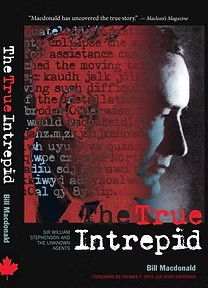
Bill Macdonald, a former teacher and journalist from Winnipeg, Manitoba, has also written two books about Stephenson’s spy days. They are listed below. [6]
Many will be familiar with the James Bond series of books written by Ian Fleming. It was claimed that Ian Fleming was trained as a spy at Camp X. [5] It was here that Fleming, while observing training, was also watchful of Stepheson. He is often quoted as saying, “James Bond is a highly romanticized version of a true spy. The real thing…is William Stephenson.”
The Quiet Canadian by H. M. Hyde (1962)
A Man Called Intrepid by William Stevenson (1976)
Wild Bill and Intrepid: Donovan, Stephenson, and the origins of the CIA by Thomas Tory (1996).
The True ‘Intrepid”: Sir William Stephenson and the Unknown Agents by Bill Macdonald (1998).
Intrepid’s Last Secrets: Then and Now – History, Spies and Lies by Bill Macdonald
“Chapter 10 (Sir William Stephenson)” by Bartley Kives, The Greatest Manitobans, Winnipeg Free Press, 2008.
References and Resources
[1] Icelandic Roots
[2] Manitoba Historical Society Archives “Memorable Manitobans: William Samuel “Intrepid” Stephenson (1897-1989)”
[3] Government of Canada Veterans “Intrepid”
[4] The Canadian Encyclopedia “Stephenson, Sir William Samuel”
[6] True Intrepid
Additional Suggested Reading
Icelandic Roots https://www.icelandicroots.com
Wikipedia – William Stephenson https://en.wikipedia.org/wiki/William_Stephenson
Britannica - William Stephenson, Canadian industrialisthttps://www.britannica.com/money/William-Samuel-Stephenson
Canadian Politics ad Public Policy: William Stephenson: The Intrepid Canadian Behind the First ‘Maple Moment’https://www.policymagazine.ca/stephenson-william-stephenson-the-intrepid-canadian-behind-the-first-maple-moment/
Manitoba Historical Society Archives: Memorable Manitobans https://mhs.mb.ca/docs/people/stephenson_w.shtml
Veterans Affairs Canadahttps://www.veterans.gc.ca/en/remembrance/memorials/canada/intrepid
The Intrepid Society, Winnipeg https://intrepid-society.org/career-highlights/


