Ontario: An “Experiment” in Icelandic Immigration
- Icelandic Roots

- Apr 11
- 4 min read
The goal for many Icelandic emigrants to Canada was to get to Gimli, Manitoba and join those who left before them. The plan was to establish Nýja Ísland, where the immigrants could be close to friends and family, and preserve their culture, traditions, and language.
However, the first Icelanders to Canada settled in Ontario. In The Icelanders of Kinmount, Don Gislason referred to it as an “experiment in settlement” because it largely failed. Only a few families chose to stay and set down roots. The rest moved on to Gimli or to settlements in the USA, and a few attempted to make a home in Nova Scotia. Today, there’s little evidence of Icelandic influence in Ontario. And yet they were there.

The first group left Iceland in 1873. Sigtryggur Jónasson, had arrived in Canada in 1872, making him the first permanent Icelandic settler. He became an immigration agent and led his fellow Icelanders from Toronto to the Muskoka area. The train dropped them off at the end of the line in Washago, Ontario. From there, the group travelled by stagecoach to Gravenhurst, and finally by steamer to northern Lake Rousseau. They named the area Hekkla*, after the very volcano that had triggered their departure.
The Icelanders were attracted to Ontario by the talk of free, fertile land and employment. They came to understand that the sales pitch had been an overstatement. Yes, there was good land available. But it was located on the Precambrian Shield. The land grants included unusable areas due to the rock. The fertile land suitable for agriculture was heavily forested and needed to be cleared. It was a challenge for the Icelanders, who lacked forestry skills. The jobs? There was road construction work in the area. It was difficult work and didn’t pay well enough to support a family.
With the government increasingly resistant to offering any real assistance, the immigrants began considering their options. Just over 100 immigrants moved to Cardwell Township, near Parry Sound, where they were closer to amenities and jobs in the lumber industry. They established a school, a post office, and a small church for the few families who settled. The rest scattered to Western Canada and North Dakota, where they heard there was better land and more of their friends and family.
In 1874, another group of emigrants prepared to leave Iceland. Their journey was fraught from the onset, and they arrived in Toronto in the autumn, when they were expected to continue north to Kinmount, Ontario, to work on the Victoria Railway. The settlement lasted all of 11 months before most of the settlers moved on to Gimli, Manitoba. The promised railway jobs disappeared when the project was discontinued.
In addition, a downturn in the Canadian economy disrupted other industries, such as lumber, where the Icelanders might find work. The free land came at a cost in time and labour to make it productive. The Kinmount group also suffered from ill health due to poor housing, lack of food resources, and the challenging climate. The Ontario and Canadian governments suffered from inefficiencies and lacked the will to help immigrants overcome their difficulties.
By 1875, most of the Muskoka and Kinmount settlers had chosen to try their luck in Manitoba or the USA. So ended the Ontario Experiment.
Ryan Eyford analyzed a common myth that the Ontario settlements failed because the Icelandic Immigrants stubbornly insisted on an exclusive settlement where they could resist assimilation into Canadian society. He concluded that the early groups of Icelanders were initially drawn to Ontario with exaggerated claims of arable land and good employment. They were not expecting to find a ready-made Icelandic enclave, but they were also not expecting to be dropped off in the rugged Northern Ontario wilderness and left to clear forests to establish functional farms under their own power.
If the Ontario settlements were failures, some of the responsibility fell on the federal and provincial governments of the time. The Icelanders demonstrated resilience and adaptability when they recognized that success in these difficult circumstances was unlikely, and they pursued more promising economic opportunities elsewhere.
What evidence of the Icelanders remains in Ontario?
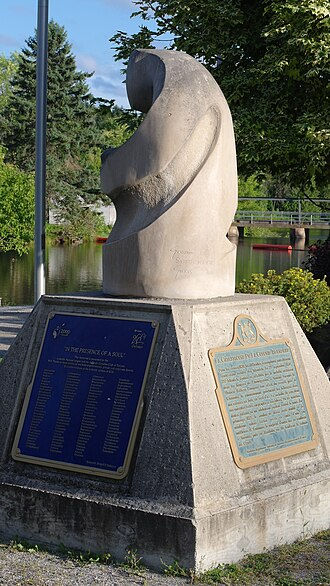
Visitors to Kinmount can find the Icelandic Settlement Disaster Memorial, also known as "In the Presence of a Soul." The memorial is at the former railway station in the village. Affixed to the concrete base of the sculpture are plaques that describe the disaster in three languages. See also the Icelandic Roots video depicting the dedication ceremony with comments from Don Gislason.
_____________________
Note
*It was supposed to be “Hekla,” but the Canadian Postal authorities erred when they sent the franking hammer imprinted with “Hekkla.” Protests to Ottawa did not lead to a correction, so the spelling remained with that pesky extra ‘k’.
Sources
Eyford, Ryan C. (09 May 2003). Icelandic Migration to Canada, 1872–1875: New Perspectives on the ‘Myth of Beginnings’. [Thesis]. Retrieved from https://carleton.scholaris.ca/items/12f5aa54-1840-4d6c-bfdb-1cfdad16f650 : 17 Mar 2026.
Gislason, Donald E. (Apr 1999). The Icelanders of Kinmount: An Experiment in Settlement. Icelandic Canadian Club of Ontario. Retrieved from: Icelandic Roots Database/Media: 17 Mar 2026.
Icelandic Roots. (31 Jul 2000). “Kinmount, Ontario Icelandic Memorial Dedication.” [YouTube video]. Retrieved from: https://www.youtube.com/watch?v=ceLX1j3uhxM&t=7s : 17 Mar 2026.
Kinmount Committee for Planning and Economic Development. (Sep 2012). “Icelanders” in Kinmount Gazette, p1,6,17. Retrieved from https://www.kinmount.ca/media/September_2012.pdf : 17 Mar 2026
Scott, Guy. “The Icelanders at Kinmount” in Maryboro Lodge Museum [website]. Retrieved from: https://maryboro.ca/story/the-icelanders-at-kinmount/ : 17 Mar 2026.
Thor, Jonas. (2002) “Chapter 4: Early Settlement Attempts in Canada” p61–71 in Icelanders in North America: The First Settlers. Winnipeg: The University of Manitoba Press.
Tiffin, Sue. (05 Jul 2022). “Icelandic group celebrates heritage, resiliency in Kinmount” in The Minden Times. [web page]. Retrieved from: https://mindentimes.ca/news/icelandic-group-celebrates-heritage-resiliency-in-kinmount/ : 17 Mar 2026.