
Halldóra Guðmundsdóttir, First Midwife in Duluth

By Becky Byerly-Adams and
Shaune Jonasson
Our settlement area this month is Minnesota. In the Icelandic settlement areas, immigrants made a significant difference within their communities and beyond. This article profiles a woman who carved a life as a caregiver in her community. Halldóra Guðmundsdóttir was loved and honoured by those she cared for within her family, but also in her hospital home in Duluth, MN. Her life was not always easy, even getting into trouble with the law upon occasion. Her legacy lives on.
Born on the now abandoned farm Elliði near Staðarstraður on the Snæfellnes peninsula on August 5, 1854, Halldóra Guðmundsdóttir (I2702), would go on to become one of Duluth, Minnesota’s most respected midwives. A 1907 Duluth News Tribune article described her as the “oldest and most popular midwife at the head of the lakes” noting she had delivered 1,100 babies - at least 112 that year alone.

Halldóra was the third of eight children born to Guðmundur Stefánsson and Anna Sigurðardóttir, though only four of the children lived to adulthood. When Halldóra was seven years old, her mother died, and she and her youngest brother Sveinn, were raised by her paternal aunt, Þorbjörg Stefánsdóttir, I503804. Þorbjörg was a midwife and under her tutelage Halldóra found her calling to the profession.
On September 28, 1874, Halldóra married Siggeir Ólafsson at Elliði. Their wedding became famous due to a severe storm, still known as Halidóru Bylur (Halldóra’s Storm), stranding the guests for three days. Over the next nine years, Halldóra gave birth to five children, though only two survived to adulthood. The family became part of the great wave of emigration, departing in 1886 from Borðeyri on the SS Cameons to Scotland, and then on to Quebec aboard the SS Hibernian.
By 1890 the family had settled in Duluth, Minnesota which had a significant Icelandic community. After learning English, Halldóra became one of the city’s first registered midwives and established its first city-certified maternity hospital in her family home. Halldóra, her husband, Siggeir, and their sons, Þorgeir "Thor" Finnbogi and Ólafur/Oliver, lived downstairs, while upstairs there were ten small bedrooms, bathrooms, and a shared bathtub which served mothers and newborns.
The 1912 Duluth News Tribune reported, “…the majority of cases which come under her care are those of women and girls who are financially unable to meet the greater expenses charged at larger institutions, that many of these come from districts where proper medical aid and care during illness cannot be secured.”
At that time, the use of forceps in childbirth was prohibited by Minnesota law, so Halldóra invented and patented an alternative “obstetrical appliance”: a ribbon placed around the newborn's jaw, which allowed the midwife to assist delivery by gently pulling on the loops.
Not all of her experiences were without controversy. On one occasion, Halldóra was arrested for failing to register a birth within the required five days. She had submitted it after fourteen and was subsequently jailed, released on bail, and fined, reportedly as part of an effort to make an example of her.
Interestingly, for those who have read Laura Goodman Salverson’s book, Confessions of an Immigrant’s Daughter, you read a first-hand account of the travails experienced by Halldóra as witnessed by Laura. This author's autobiography emphasized the truth about Laura’s upbringing and her family’s plight while striving to create their new life in North America.

Salverson also emphasizes, with consideration and circumspection, the rise of the women’s rights movement. This mention is in part due to the era when Laura was coming of age but also observing many female role models including her father’s sister, known to Laura as Aunt Halldóra, a well-known and revered midwife in Duluth.
The Goodman family (the surname Guðmundsson changed during immigration) moved to Duluth at the behest of Halldóra claiming they would have a better chance of finding their way. Whether planned or not, Aunt Halldóra often became the family’s benefactor. She portrayed a contrasting disposition from that of Laura’s meek mother; they were two very different women.
As for Halldóra’s brother, Laura's father, Lárus (or Lars), he had his own challenges meeting his expected role. He was a passionate thinker, wanting better things for his family. Alas, with his thoughts more akin to an explorer rather than a labourer, the family became somewhat nomadic, appeasing his wunderlust.
Moreover, it was in Duluth where Laura observed Aunt Halldóra; she claimed her aunt wore her personality outwardly. Halldóra was her own unique self, with a heart full of compassion for those in need, ruled by her mind’s practicality.
Of her aunt, Laura Goodman Salverson captures Halldóra’s character. From the book Confessions of an Immigrant’s Daughter:
Presiding at her table, Aunt Halldóra seemed to me a figure out of a Viking legend: impersonal, cold, but sincerely concerned with the fate and fortunes of her ragged, impecunious guests...never in this world or any other world could I hope to attain the magnificent statue of my aunt, or clutch for my own sustainable self-esteem…
Every gesture of her really beautiful, well-kept hands fascinated me. The curt way she spoke, which brooked no doubts nor opposition, was a revelation in forcefulness. Everything she did and everything she thought and everything she expressed in words was so firmly fixed in a sense of absolute perfection, according to her lights, that even the most foolish person realized the futility of opposition. That she was an autocrat in every sense of the word is certainly true - but the sort of autocrat who rigidly abides by, and at all costs maintains a moral code predestined for a certain cast by an all-wise deity. She was utterly sincere and utterly without vanity. Her person, like her house, was dedicated to service…Her whole life was centred in her profession, of which she was justly proud. And, unlike most married women who dabble in professionalism, she had the good sense to leave the details of housekeeping to others. That was not her business. Often enough she was cheated in the kitchen, where a wasteful cook might happen to rule at the moment. Well, what of that? Such people knew no better! That phrase, more than any other, sums up my aunt’s character. With all her heart she believed that ‘the lower order’ were as God had made them. How foolish, therefore, to expect any sort of perfection from the poor creatures…Conversely, she was critical and severe and alert for signs of shameful weakness in those who ought, in themselves and their behaviour, to be a credit to a decent family.
After Laura's family had settled into a “hideous barn of a house” in the Duluth area, Aunt Halldóra continued sponsoring their welfare. The family’s resources were meagre and soon Laura’s father left for Winnipeg to earn a wage. Laura's mother received the wages with a sense of relief and cautious excitement. She vigilantly tucked them away, bit by bit, improving the family’s situation. Upon her father’s return to Duluth, Aunt Halldora remained an ardent supporter.
Halldóra had a strong sense of community spirit. Salverson writes about their neighbours, a family that fell victim to a fire that destroyed their home and belongings, leaving the family safe, but only clad in their nightclothes. Halldóra sourced a home for the family, paid their first month’s rent, furniture, bedding, kitchen needs and clothing. The grocers and coal suppliers also supported her appeal. Halldóra also went so far as to facilitate the older daughter in attending business college without the expense of tuition or books.
[Aunt Halldóra] was not the kind of woman to whom one offered excuses. The glance of her penetrating grey eyes, and the slightly scornful curl of her firm mouth, was much too disquieting. Moreover, even silly people recognized the absolute justice of her personal attitude. If she asked for anything it was because the thing had to be done, and the doing of it somehow acquired honour.
Laura continued to learn about the strength and wisdom of her Aunt Halldóra. The challenges of childbirth in the late 1890s and early 1900s were prevalent. Laura writes about a night where, when delivering cream to the kitchen, the house appeared abandoned. Her thoughts were soon drawn to wails from an upper floor of the house. Meeting the cook on the stairs, tears in her eyes, and holding a newborn infant, the cook expressed “She pulled her through! She saved them both! Dear Lord, I never saw such a woman!”
This last passage was where we learn Halldóra had used her creative version of forceps to assist with a difficult delivery. It was a small miracle.
Halldóra spared no time for herself, but selflessly tended to the survival of her new mothers and their offspring. She raised an orphaned, infant twin girl to a young age, with the intent of adopting her. That is until two elderly spinster sisters learned of the girls heritage and decided they, as the girl's surviving family, would do best raising her. Reluctantly and with a broken heart, Halldóra relented to the aunts' request.
From Laura Goodman Salverson's memoir, we learn that the expressions of duty and care portrays the eminence of Aunt Halldóra to Laura. Halldóra always cared for her family. Over the years, others in need benefited from Halldóra Gudmundsdottir and she became legendary in her own time. Her hospital home became the sanctuary for girls and women from across the State as well as from Ontario.
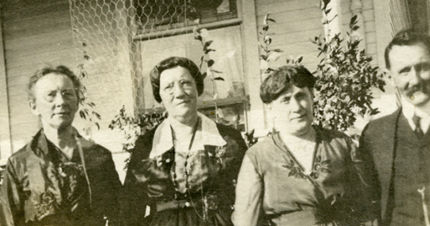
Halldóra Guðmundsdóttir, midwife, inventor, loving wife, mother, sister, aunt, and grandmother, died at her son Oliver’s home on October 28, 1921. She was buried next to Siggier in Oneota Cemetery in Duluth.
Editor’s Note: For those who may be interested, Icelandic Roots has a monthly Book Club meeting. The books are chosen as a story with an Icelandic connection or an Icelandic author. Often, we have the author as a special guest. This combination always results in very interesting discussions.
Laura Goodman Salverson’s book Confessions of an Immigrant's Daughter was the featured book for the February 2026 Book Club. Check out the Icelandic Roots web page and the Event Calendar for future Book Club selections and dates.
Resources and Additional Reading:
Icelandic Roots Genealogy Database Icelandic Roots | Genealogy Ancestry
Gordon C. Krantz
Halldóra Guðmundsdóttir - Duluth Midwife
Björg Einarsdóttir
Ljósmæðratal, (Prentsmiðjan Oddi hf.), 18 Dec 2017, p. 242
Curtis Brown
Star Tribune, Minnesota. 03 Jan 2015
Salverson, Laura Goodman. Confessions of an Immigrant’s Daughter, 1939. Faber and Faber Ltd., London, England


