
Growing up in Lundar
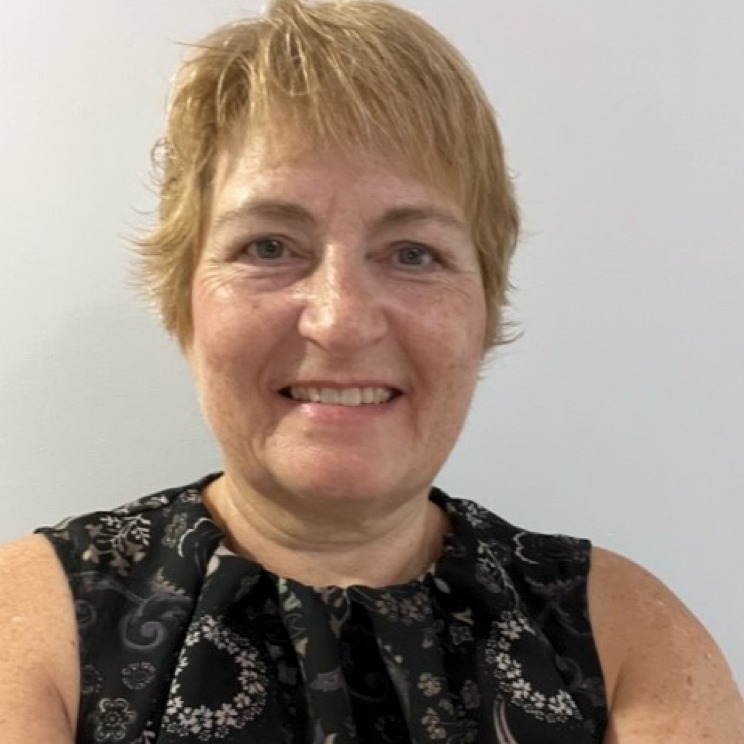
by Patty Johnson
Patty Johnson and Becky Byerly-Adams were guests on Samtal Hour, a member's only conversation hour normally held bi-weekly that shares all things Icelandic. On Monday, 14 July, they spoke about their roots in the Lundar and Interlake Region east of Lake Manitoba. This article is a transcript from Patty who shared her fond memories and heartfelt reflections of growing up in Lundar.
Where is Lundar?
Originally the Swan Lake Settlement founded in 1887, Lundar is a hamlet in the Rural Municipality of Coldwell on the eastern shores of Lake Manitoba in Manitoba’s Interlake Region (between Lake Manitoba and Lake Winnipeg). The RM of Coldwell was created on March 24, 1911 and its first year of operations took place in 1911.
Lundar is centrally located in the RM and is the community hub of business and gathering. It has as its symbol the Giant Canada Goose. The Population as of Census 2021 is 1313 for the RM of Coldwell and 499 for the Lundar, Local Urban District.

“The pioneers laid the foundations, cleared the bush and broke the sod. They began dairy and cattle farming and the fishing which became the main industries. Many homesteads have been vacated and formed into larger farmsteads. The piles of stones on deserted places are silent memorials to those who toiled so hard and faithfully. The achievements of the pioneers are a source of inspiration to their descendants. They maintained their cultural identity, acquired citizenship papers and were proud of Canada, their new home. In later years, they intermarried freely with other nationalities and although many of the young people do not speak the Icelandic language, they value and are proud of their Icelandic origin. They are happy to be Canadians and loyally serve their country” (Wagons to Wings, 1980 p. 12).

My experience growing up in Lundar started in 1960. I was born on June 22nd of that year in the nearby EM Crowe Memorial Hospital in Eriksdale. The Doctor who delivered me was a well known Obstetrician who had been raised east of Lundar and lived in Lundar; he was our neighbor next door. Dr. Gudmundur Paulson (I563017) was respectfully and affectionately referred to all his life as “Doc.”
I started my life in the “old house” on Main Street which my Dad had purchased from Magnus Kristjanson (I523405). He was the maternal Afi to the Johnson family and you may recognize some of these names: Donald K Johnson (who just received the Companion Order of Canada in 2026), Cecil, Paul and Margaret Reykdal (F.192002).
When I was one year old, we moved into the new house that Dad built on the same property. Soon after, my Afi Kjeli (Rafnkell Eirikson I431791) moved in with us. Afi lost his wife in 1939, and became blind from glaucoma soon after. He lived with his children from then on, except for a short stay at Magga Bjornson’s (I216818) old folks' home in Lundar. His last stay was with Aunty Steina (I431779) in Big Point by Langruth. In 1972 he became frail, landed in Portage la Prairie Hospital and passed away. He was 92 years of age.
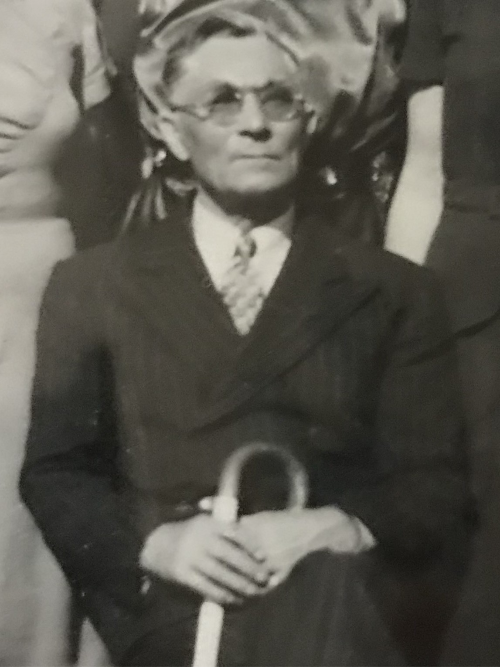
Afi lived with us for about 21/2 to 3 years. My memories of him are all good: he was always soft spoken and kind and I don’t recall him ever complaining. He had a connection with the Canadian National Institute for the Blind. He read braille and he laced leather wallets. He sold some and gave some to family.
My bedroom was across from his and I recall watching him doing his morning stretch exercises by his bed. This he did daily. His attire was always clean and neat. He wore pants with a belt and a shirt with a woolen vest over top. This meant he always had that smell of wool. Finally, he would put on his dark glasses that had a blue tint to them so you could not see his eyes.
After this he headed to the breakfast table with his white cane and, it seems to me, most times he ate oatmeal with milk and golden syrup and a cup of hot water with milk and molasykur (sugar cubes).
He loved the outdoors. He had a fishing line from the house to a backyard oak tree and would walk this daily. I also remember him sitting in the green metal chair at the back of the house.
Another memory (funny for me but not so much for him): My sister must have been a baby and I was about 3 because my Mom had me walk Afi over to Doc Paulson’s for an appointment. Mom watched out the window as I walked with Afi. Well, I was taking the short cut through the yard through the lilac trees. I remember pulling on his hand as he walked with me with white cane in his other hand. I heard him say “whoa whoa” and when I looked back, I realized I was small enough to walk through the space of the lilacs but he was too tall and the wee branches were catching him.
Visiting his Icelandic friends meant driving with him and Dad. The first of two places that I remember vividly is the Johnson’s farm east of town (Mom Margaret, and children Hjelti, Ragnar, Rosa and Paula. There was only one sister, Hleif who was married and lived in the Langruth area (F191572). Margret was 90. She was a little lady with round granny glasses, grey/white hair in a bun, skirt, sweater, stockings, and sat on the edge of her bed. The sisters lead me to her to sit with her on the bed. I remember not being frightened even though she only spoke Icelandic. She held my hand and spoke softly. Rosa and Paula would translate. They were the nicest people.
My second visiting place was that of Asa Fjelsted’s parents (Asmundur -Asi and Gislina Freeman (F216517). They lived many years in the Siglunes area and may have known Becky’s relatives [author refers to Becky Byerly-Adams, IR member and volunteer]. They then moved to Gypmsumville area but retired to a small house by Asa and Joe’s (F216516). The Fjelsted and Freeman homes were about a mile south of town. Both houses have been empty for years but still remain standing [and can be seen] as you drive south on Provincial Hwy 6.
Mr. Freeman was also blind. He and Afi would get settled and Mrs. Freeman would read the Icelandic news to both. She served coffee, of course. I recall an opening from the kitchen to a bedroom and she had me follow her into this room. I was nervous. She opened the top drawer and pulled out a brown paper bag. She reached into the bag, pulled out a plum and handed it to me.
I recall Afi giving a piece of fruit when I visited him at Aunty Rakel’s (I85482) place. It is only now that I am older and have visited Iceland that I realize how special and meaningful these gifts of fruit were. The giving of fruit by pioneers is one of my favorite stories to share with others. The meaningfulness of a piece of fruit is such a show of love.
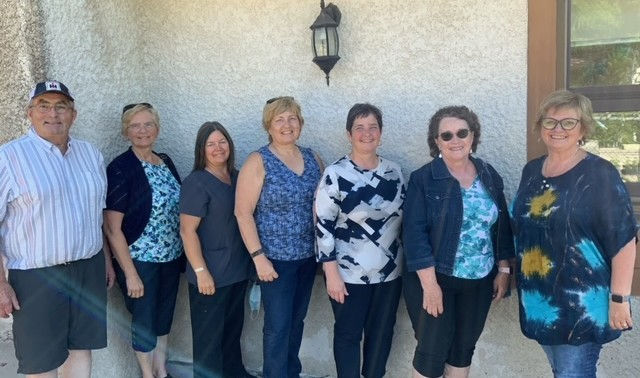
Living in Lundar meant being part of a community. Relationships have always been important to me both in my personal life and my professional one. I was fortunate as were many other children in Lundar to have lots of relatives living nearby.
My Dad, who was my Icelandic side, had four siblings and all but one lived in Lundar. My Dad was older when my sister and I were born so these cousins were mostly 10-18 years older than us, but they always had time to say hello, share a coffee and chat. My Mom was from a family of twelve and five of her siblings lived in Lundar; as well, five of these twelve married Icelanders. Needless to say, there was always someone to play with. Baseball, road hockey, Wednesday public skate at the local arena, and curling teams [were] made up of aunts and cousins.
Going to school was eye opening regarding the language. While names like Einarson, Bergthorson, Eirikson, and Guttormson rolled off our tongues, teachers new to the area felt it very challenging to speak them. Many butchered the names or tried pronouncing based on sounding out in an English way; this didn’t work so well.
This also got me thinking of all the nicknames in the community. Was it because saying first names like Bergsveinn, Asmundur, Snaebjorn, and Gudridur were difficult that so many nicknames were used? Some interesting ones include Slivers, Silent Night, Step and a half, Chiclets and DoDo to name a few. Is this more an Icelandic thing or just what happens in small communities? Hmmm!!
Another taken for granted experience was unannounced dropping in for coffee or if around meal time, feeding people a meal. [It] was just done. Lundar women always offered coffee and always offered more than one treat; vinarterta was usually in the freezer so could be put out along with a cookie or another treat like pönnukökur. Coffee was most often made in the sock when I was little but now, it's mostly a Keurig type machine or drip coffee maker. I think “food as hospitality” speaks to the historical support and social ways that Icelanders showed travelers making their way to homestead, or passing through on their way to their homes.
Besides Lundar connections, it was not uncommon for visiting to occur in other Icelandic communities or marrying into an Icelandic family from another settlement. Many area elders spent time in Gimli Betel, a care home. The annual Lundar Agricultural Fair brought farmers and their families from miles around, many of them Icelandic. Lots of 4-H kids marched in the parade and took part in the show and sale of their steers; this continues still.
When I went to university I met Lenore, [who was] also Icelandic from Arborg. It was so nice to have a connection “from home”, the Interlake. This connection continues to this day.
An example of marriage was my Mom’s best friend’s daughter, June. She married Bud Eyford (I550126) who came from Siglunes. They lived in Lundar and their three children went to school in Lundar for many years at the same time as me. The Eyford name may be familiar to those of you who have heard Becky (I534403) talk about her family connections in the Vogar/Siglunes area. In fact Bud is Becky’s cousin once removed. Becky’s Amma Emelia (I166170) and Bud’s mother Baldrun (I 166167) were sisters.

I could never have imagined how Icelandic Roots would connect me to Becky, then from Colorado now in Washington state, who had connections to the little settlements of Siglunes and Lundar.
As I get older and think about growing up in Lundar I realize the influence my Icelandic community has had in my ongoing life. My first part-time job as a nurse was at the newly opened Lundar Personal Care Home in 1982. At least half of our first residents had been born in Iceland. It was so interesting to talk with them about their lives and how things changed, [for example] Little Mrs. E. remembers cooking over an open kettle over a fire then lived to enjoy electricity; who always had cod liver oil at breakfast time; whose friend was Harold Bessason from the Icelandic Department at the University of Manitoba.
Other influences include the making, sharing, and eating vinarterta each Christmas, or special occasion treats like pönnukökur and kleinur with coffee, or rúllupylsa with brown bread, hardfiskur (Harðfiskur). For us, [it was] made out of Jack fish (aka Pike) or Pickerel or Perch.
Other influences that remain are the Lutheran Church Sunday School Christmas concerts, serving meals to friends and family, donating food and time to various community events. They all seem to include coffee and sandwiches, dainties, and cookies; the love of using a “real” pönnukökur pan, the many fish nets that were used and women who mended them, the many women who knit woolen mitts, fish being a staple diet item, my Dad, Afi, and Langafi and so many Icelandic uncles and cousins who have been fishers (anglers yes, but many were ice fishers). Wearing Icelandic shawls for special occasions and sweaters, lopapeysa. They they are still worn today although fewer local women knit them.
I continue to live in Lundar. I live on the property where we had a mink ranch when I was growing up. My husband and I took it over for 10 years ending in 1990. My sister lives in the house in the town of my childhood. Although the nationalities have changed and the number of Icelanders has decreased, the Icelandic influence still remains in Lundar.
In 2022 I joined Icelandic Roots as a volunteer. As a result of IR, I have had the exciting opportunity to meet up with Becky twice in Lundar in the past few years. She was checking out her Icelandic roots in the Vogar/Siglunes area and, for her to head to Winnipeg, she passes Lundar and my home. It is so interesting to not only see the connections on the database, but to actually meet and feel these connections.
Our Icelandic connections are rooted in kinship and shared heritage. Throughout this article Patty has listed many of the IR#'s for the family and friends. Patty Johnson's IR# is I229236. As a full access member, you can check the relationship calculator to see you may be related.


