
In Search of the Lost Children

By Becky Byerly-Adams
[Condensed for Rætur Fréttir/Roots News]
As we learn about our heritage, the connection to our ancestors strengthens. It intensifies when opportunities exist to see where they once lived, stand where they stood, walk where they walked. The ultimate connection is finding their eternal place of rest.
Growing up in non-Icelandic communities in the United States, long after my Iceland-born grandmother had passed, I was proud of my heritage. Yet I knew little more than a few scattered tidbits. One story my mother shared has stayed with me: a family tragedy had occurred in the early 1900s on the eastern shores of Lake Manitoba.
In 2024, while attending my first-ever August the Deuce and Íslendingadagurinn with my sister Robin, we stopped to view the farm of my great-grandfather's uncle, Indriði Sigurðsson (I17440), near Mountain ND. This is where my great-grandparents Jörundur Sigurbjörnsson (I166166) and Anna Jónasdóttir (I14403), along with their three children, Baldrún, Sigurbjörn, and my grandmother Emilía (Emily), spent their first winter after emigrating from Húsavík in 1893.

Within a year, the family left the United States and immigrated to Canada, staying with another uncle, Jón Sigurðsson (Indriði’s brother). Their second son, Jónas Sigurvin, was born in Manitoba on August 6, 1894, and a third daughter, Guðbjörg was born at The Narrows on January 29, 1896. Named after a sister who had died in Iceland, she also died in infancy.
In 1896, the family moved south to Siglunes, a place family lore claims Jörundur named after the place in Iceland where he had been a renowned skipper on the ship Hermóður in Siglufjörður.1 They eventually took a homestead in the northwest area toward the lake, living there for seven years, during which four more children were born: Ragnhildur (1898), Sigurður (1900), Kristjana (1902), and Jónasína (1903). Sadly, Jónas died around the age of five.
Jörundur worked as a fisherman on the lake, a mailman, and a homesteader. Their family name was anglicized to Eyford, taken from the fjord near where they had lived in Iceland, Eyjafjörður. They were well respected, and life seemed good. And then tragedy struck in the fall of 1905.
A traveling salesman was invited to spend the night, and he unknowingly brought diphtheria into the household. Quite rare today in developed countries, thanks to the vaccine; diphtheria was a harrowing disease. Its name derives from the Greek diphthera, meaning "leather hide," which describes the distinctive, leathery membrane that forms in the throat, suffocating its victims. My grandmother, Emily, then 13 years old, was the first to fall ill, followed by the four younger children. There was no doctor in the area, and although an antitoxin had been developed, it had to be imported and kept refrigerated, making it expensive and desperately scarce.
Jörundur and Anna worked tirelessly, day and night, trying to save their young children, but to no avail. The first to die was 6-year-old Ragnhildur, on October 2nd. Then, on October 4th, 3-year-old Kristjana was gone. October 5th was the worst of all, with both 5-year-old Sigurður and little Jónasína, who was only 8 days from her 2nd birthday, succumbing to the disease within a few hours of each other. My grandmother awoke from her fevered state to the sound of her mother crying, mourning the loss of her four younger children.
An Icelandic minister from Winnipeg, Dr. Rögnvaldur Pétursson, conducted the funeral service, with people coming from miles around. The four little children were buried in a single casket near their first home in Siglunes, where Jónas had also been buried, since there was no cemetery in the community. While I'm sure a marker was erected at the time, it has not survived. The family installed a memorial cairn in the early 1990s.
This well-known tragedy was recounted in many newspapers, community histories, and books.
In a deeply moving obituary/memorial piece written by “A friend of the parents” and published in the 19 April 1906 Heimskringla:
“They were all laid in the same grave and were buried at home on the farm. Those were sorrowful days for the parents, carrying out one body after another to an empty house that stands there in the yard, until all four had been taken away, and then, for the father, to dig the grave for them and lay them to rest himself. But there was no other choice.”
It goes on to say:
“They have a flourishing farm by Siglunes Bay, and have enjoyed good fortune in all their affairs up until now. But with this sorrowful loss, a large part of the happiness they had previously enjoyed has vanished — fallen into the earth with that part of the household which now rests as corpses there along the bay. Yet cheerfulness often fades, even over lesser griefs than this. It is beautiful to look southward along the bay there — but for those who suffered this loss, the rippling waves of the water bring to mind the low, quiet resting place of the young siblings who died.” 2
Now, 119 years later, I was in Manitoba for Íslendingadagurinn. Since I was so close to the old homestead and memorial cairn, I met my cousin Ryan Eyford. He graciously offered to take my sister and me up to Siglunes, with permission of the homestead owners, to see the land where my family had lived, and the spot where the five children were buried.
Ryan, my sister Robin, and I drove up to the old homestead to meet Laurie Emilson, the son of the farm owner, and Dennis Gíslason, another Eyford cousin. Laurie and Dennis both had ATVs and had spent almost two hours looking for the cairn by the time we arrived. The three of us started searching as well. We tromped through waist-high grass, trying to catch a glimpse of the marker. Laurie explained that floods in 2011 and 2013 had removed many of the trees he used as landmarks. We finally had to accept that we could not find it among all the grass and brush.
My disappointment was palpable. I knew my grandmother felt enormous guilt, being the first to fall ill and the only one to survive. I had to leave Manitoba with a desire still burning to honor the memory of these four little children by bringing them flowers and telling them they had not been forgotten.
I later heard from Ryan that Laurie’s dad, Mark Emilson, had gone out to the cairn himself, since he knew exactly where it was. He sent a current photo, along with a photo from a long-ago newspaper article. But I would not be satisfied until I could stand on the ground beside them myself.
In May 2025, I was back in Manitoba for the INLNA convention. Despite it being spring, snowstorms were still possible. Ice covered much of Lake Winnipeg, but no snow was in the forecast. I was determined to find the gravesite of my grandmother's siblings.
Mark Emilson advised me to pack my tall boots, as we would likely be walking through mud. A dear friend, Patty, who lives in Lundar, MB, said she would lend me hers. I took her up on the offer and headed back to Mark’s farm near Siglunes.
Driving the deserted rural roads of the Interlake region of Manitoba, I marveled at all the reminders of the Icelandic settlement here. The blue farm signs brought back memories of places I had visited in Iceland. My mouth watered as I drove through Arborg, remembering the Icelandic brown bread I had bought from their bakery the summer before. I listened to the radio, switching channels frequently since the reception was spotty at best, before finally turning it off. And I fought the wind that kept pushing my car towards the center's white line.
As I drew nearer to Siglunes, I began to think about my great-grandparents. Tears sprang into my eyes, imagining their helplessness in caring for their children suffering from diphtheria. How grief-stricken they must have been, losing four children within three days!
After much guesswork, reversing course, and finally asking a stranger to lead me to the
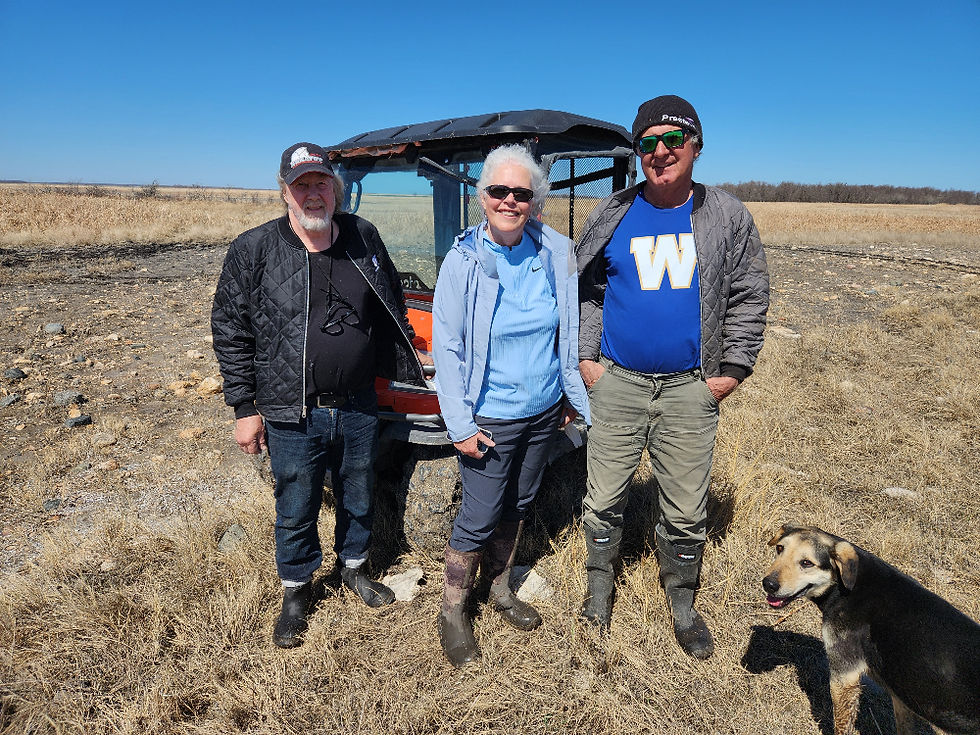
Emilson farm, I pulled into the driveway and introduced myself to Mark. My cousin Dennis had joined us, along with Finn Jonsson, who had grown up on a nearby farm. He had visited the gravesite as a child and wanted to be part of this expedition.
Wearing my borrowed boots, I rode with Finn in his pickup, towing his ATV. Dennis drove his own ATV, and Mark fired up his quad. We soon turned off into a field where Finn unloaded his ATV. I climbed onto Mark's quad, making room for Wags, Mark's old dog.

Mark led the caravan through cow fields, skirting mud puddles and standing water. Despite our best efforts, the quad became mired in the mud and could go no further. I got out and immediately sank Patty’s boots into the muck. With Finn on the ATV pulling, and Dennis and I pushing from behind, we finally freed the quad.
We had not yet arrived. We continued on foot, sloshing through mud and water, until we reached dry land. Mark guided us toward a grove of dead oak trees we could see in the distance. Three large eagles circled above that area, and we soon spied their

enormous nest, which was empty. They continued to circle but allowed us to continue our journey.
Our final hurdle was to climb through barbed-wire fencing that had been knocked down, probably by cattle. Clearing the fence, the cairn erected in recognition of the lost children appeared before us.
Approaching it, I was struck by the silence and loneliness of the final resting place of these children. It was an unseasonably warm and windy day. I could look out and see water both to the east and to the west, and I realized we were standing on a point of land stretching into Lake Manitoba. Overhead, the three eagles continued to circle. If only the oak trees had survived the floods. It must have been a beautiful place when my great-grandparents chose this spot to build their home, and eventually to bury five of their children.
Mark, Dennis, and Finn stood back while I walked up to the cairn and placed my flowers upon it. It was a solemn moment, and I was overcome with emotion.

On the other side of the cairn were the names of three more people: Jónas Sigurvin; 73-

year-old Vigdís Jónsdóttir Peterson (I46423), who had been a neighbor across the bay from the family who died in 1903; and Jónasína Grace, a child of Baldrún, the eldest daughter of Jörundur and Anna, who died in 1912.
We also discovered two more headstones lying on the ground. One was for Páll Helgason (I337033). The other was most likely for two sisters, Ella (1900–1908) and Dagmar (1895–1908) Anderson, but it was quite difficult to read. This appeared to have been a small cemetery. The Manitoba Genealogical Society calls this burial site the Siglunes Icelandic Cemetery , with ten people buried there.3
After about 15–20 minutes of quiet contemplation, we trudged back to the vehicles, the eagles still circling above, and then returned to Mark’s farm.
Mark and his wife, Jovy, invited Dennis and me to stay for coffee, and we talked for almost two hours. Mark gave me his precious copy of The History of the Icelandic Settlements at the Narrows, Manitoba by Geirfinnur Peterson, which had been serialized in Lögberg-Heimskringla in 1969–1970.4 He shared an article, "Live Here. Be Remembered," written by his ex-wife Karen Emilson and published in the Manitoba Co-operator.5 Both publications recounted the tragedy, which Karen also fictionalized in her novel, Be Still the Water.6
Later, as I climbed back into my car, I felt a deep satisfaction in knowing I had completed my quest to find the cairn and honor these lost children. My heart was filled with the kindness of people along the way, without whom I would have failed to meet my goal.
There remains one last task ahead of me to commemorate the children lost to Anna and Jörundur: I must contact the current landowner and ask permission to clean up, and perhaps fence in, this small cemetery.
I started the car, rolled down the window to let in the fresh air, and turned on the radio. Immediately, "Free Bird" by Lynyrd Skynyrd began to play; the lyrics, “If I leave here tomorrow; Would you still remember me?” drifted out over the quiet fields.
___________________
Author’s note
Exact details often clash between family lore, genealogical records, and newspaper articles. I have done the best I can to verify information.
___________________
Sources
“Karl Kristjánsson ræðir við árna í skógum: Áskuminnigar um héðinshöfða og Benedikt Sveinsson sŷslumann.” Timinn: Sunnudagsblað. 07 Feb 1965 p102. Retrieved from: https://timarit.is/page/3553551 : 27 Aug 2026.
Vinur foreldranna, “Þúngbær missir” Heimskringla, 19 Apr 1906, p1. Retrieved from: https://timarit.is/page/2152298 .
Manitoba Genealogical Society [online database]. mbgenealogy.com
Peterson, Geirfinnur. “History of the Icelandic Settlements at the Narrows, Manitoba.” [first of multiple installments from 16 Jan 1969 to 15 Jan 1970]. Lögberg-Heimskringla. 16 Jan 1969, p4. Retrieved from: https://timarit.is/page/2230227 .
Emilson, Karen. “Live Here, Be Remembered.” Manitoba Co-operator. 26 Jul 2001, p15.
Emilson, Karen. Be Still the Water. 2016: Winnipeg, MB, Perpetual Books.
Additional Sources
Ashern Historical Society. Taming a Wilderness: A History of Ashern and District. 1976: Ashern MB: 1976. Retrieved from: https://digitalcollections.lib.umanitoba.ca/islandora/object/uofm%3A2276635#page/1/mode/2up : 27 Aug 2026.
Halverson, J.A.. Siglunes District. [digitized document]. 1955. Retrieved from: https://digitalcollections.lib.umanitoba.ca/islandora/object/uofm%3A3109719#page/1/mode/2up : 27 Aug 2026.
The IR database and genealogists are always a goldmine of information.


