
Icelandic Settlements - The Saskatchewan Story

by Shaune Jonasson
Settling the untamed land of the Canadian prairie, originally known as Assiniboia in the North-West Territories (NWT) before Saskatchewan was a province in 1905, was fulfilled by many ethnicities, including our Icelandic ancestors. Filing for homesteads, then carving out a living in this vast open land was no small feat. Viking courage harmonized with a pioneering spirit; the Icelandic settlers became an important element of Saskatchewan’s tapestry. They left a lasting imprint.
Saskatchewan features diverse landscape with everything from the rugged Canadian shield shaped by glacial activity, boreal forest, muskeg and swamp in the north, to shallow valleys and plateaus, rolling hills and of course the beautiful plains. Throughout the prairies, settlers filed for a homestead at the cost of ten dollars per claim which granted them 160 acres, a quarter section of land, along with a set timeframe stipulated for the development of the land and buildings. 1
The NWT, soon to be Saskatchewan, welcomed the Icelanders to the prairie landscape. From other settlement areas they travelled west and north seeking better farmland for growing grain and raising livestock. There were three main settlement areas from essentially two migration groups. 2
One of the migration groups were those who immigrated directly from Iceland to the Canadian prairie. The second group had previously emigrated from Iceland and had acquired significant knowledge and experience. They adapted to the different climate, instilling confidence to further explore Saskatchewan.
Additionally, this second group of settlers included younger men and families ready to strike out on their own. Having immigrated as infants or young children, or were soon born, they were all raised in North America. They honed their skills through farm labour, building homes, roads and railroads; and working in business. Plus, they acquired a good command of English. Fewer homestead or business opportunities were available for this generation, unlike their parents. They were enticed with the offer of a homestead and associated grants in Saskatchewan; a significant draw as many did not have the resources to buy a farm or business near home.
THE FIRST SETTLEMENT PERIOD
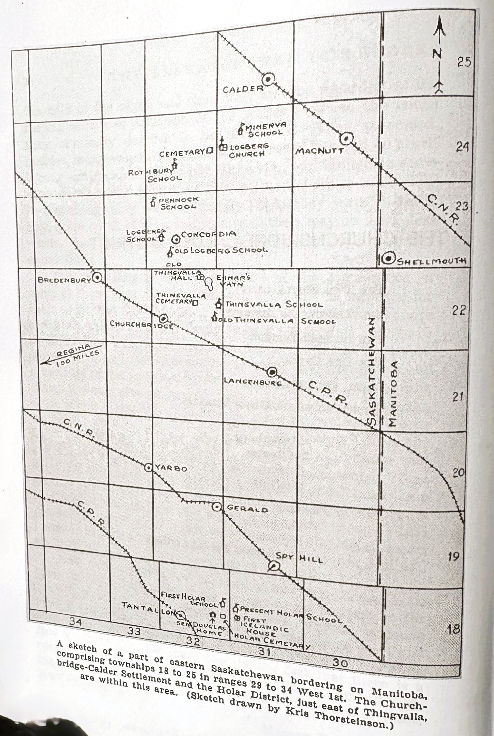
Three districts were settled during this first phase in 1885: Churchbridge-Calder district, the Holar district and Foam Lake area.
Churchbridge - Calder District
Thingvalla area was named after the homeland of its Icelandic settlers. The first homestead grant was filed in 1885. Seventeen families soon followed and focused on building their “shanties.” South-facing hillsides were dug out, the walls and a roof were made of poplar trees and sod. The next important task was to ensure hay was available for the livestock, and it was enough to get through the impending winter.
This area was ideal for mixed farming with its slightly rolling hills and depressions that could become dry but filled with water after rain or snow melt. Poplar and willow were plentiful and good for building houses as well as furniture.
Lögberg about 25 km northeast from Thingvalla received its first group of setters in 1890, with a peak in population in 1890. They were drawn to the open land and water. However, during the prairie droughts, many wells dried up forcing many to leave.
The dreadful winter of 1892-1893 was another factor in the reduction of almost half of Lögberg’s population. Families left for areas that were more familiar to them. Soon other immigrants, not just Icelanders, began to arrive and the population grew again.
These two communities became united known as Thingvalla-Lögberg. They were initially established under the Concordia district, but now are under the present day Churchbridge-Calder district.

Churchbridge, a more English community a short distance west of Thingvalla, received additional Icelandic settlers in 1887. The railroad arrived in 1888 prompting increased population that in turn generated commercial opportunities, of which some Icelandic businessmen capitalized upon. Eventually, the shanties were replaced with log homes. Rooming houses, hotels, eateries and drinking establishments became plentiful. Business that offered agricultural and livestock support grew exponentially, reflective of the area’s livelihood.
Other towns further west on the rail line, Bredenbury, Saltcoats, Calder and MacNutt, Spy Hill, and Gerald experienced growth but not as many Icelandic settlers remained in those areas.
Holar district
Tantallon area was originally designated as a Scottish settlement, but they never did arrive. The name came from a castle in Scotland. In 1887, a small group Icelandic settlers reached the area with their team of oxen, a cow and a wagon. These assets were shared amongst the community, supplied as a courtesy of The Northwest Loan Company. This organization was established to assist with the colonization of the then NWT.

Stockholm, a settlement designated for Swedish settlers east of Tantallon, also received the Icelanders. It is a picturesque area situated along the edge of the Qu’Appelle Valley with fertile land and large poplar trees and willow bushes.
The Holar district eventually became known as the Tantallon district. More Icelanders arrived in the 1890s.
Foam Lake district
By 1891, the rail line ended in Yorkton, an area northwest of Churchbridge. After experiencing the droughts and well-water shortages, news of wetlands further northwest of Yorkton with plenty of tall grass fields sweeping the horizon travelled quickly.
Two of the earliest Icelandic settlers in Thingvalla set out by oxen cart heading west of Yorkton by 90 km (approx. 58 miles) exploring the area of Foam Lake, named as such when earlier settlers saw foam along the shores of marshlands. The area had an abundance of hay for livestock and poplar trees for building. Many relocated from Thingvalla to Foam Lake. More Icelandic settlers followed. By 1902, nineteen families had settled here.
The lack of a rail line to access supplies was one of the challenges faced by Foam Lake settlers. The nearest commercial centre was in Yorkton. The community formed a team that would travel twice annually by cart to Yorkton for supplies. Once the railroad arrived in 1907, it alleviated the long-distance travel for supplies. The population expanded as did the town’s businesses.
THE SECOND SETTLEMENT WAVE
For approximately ten years after the turn of the century, settlers from other Icelandic communities relocated to Northwest Territories/Saskatchewan.
“Vatnabyggðin” - the Lakes Settlement
The largest Icelandic settlement area in Saskatchewan stretched about 72 km (45 miles) long beginning west of Foam Lake to the region of Dafoe, included the Quill Lakes and numerous smaller lakes. It was 32 km (20 miles) at its widest point. It became known as “Vatnabyggðin” or the Lakes Settlement.
The gently rolling hills and bluffs where willow and poplar grew in abundance was best suited for mixed farming and provided materials for building. They had fields for growing grain; others were best for hay. The sloughs in the low-lying areas filled with water during wetter seasons or from the spring’s snow melt, making it tough to work the fields. Travelling further west they found flatter land with fewer trees and bluffs. This area required far less effort to clear the land and was more conducive to growing grain.

Kristnes settlement started in 1903. A year later the post office was established, followed by a small store, a trading post, a blacksmith shop. These resources were started within the owners’ homes. A once well-established settlement eventually diminished; people and businesses left for the larger centres.
Wadena, located on the Canadian National Railroad (CNR) line from Dauphin-Humboldt-Edmonton, became a natural stopover for travellers. This resulted in the opening of a general store, a lumber yard and lodging facilities available.
Leslie, situated west of Foam Lake, was the final stop of the rail line in 1907, with no further expansion until after 1908. Like many small towns along the rail route, it had a general store, post office, an implement business and hardware store. A larger migration of Icelanders and others arrived in 1908. The Icelandic celebration of “Þorrablot” became a regular event bringing many in the district together annually.
Mount Hecla and Holar District, settlements were not long established. (It’s not to be confused with the Holar district near Tantallon.) The land was difficult to cultivate with small field areas. These residents soon became members of Foam Lake, Leslie and Elfros communities.
Elfros saw its first Icelandic settlers in 1903 with the arrival of five families, with substantial growth in the following few years. The arrival of the railroad in 1908 stimulated more business; in particular, a general store, lumber yard, an implement business and a post office. Elfros was incorporated as a Rural Municipality (RM) in 1909.
It was well known for its “unique type of church union… Scottish Presbyterians and Icelandic Lutherans”. 3 The Union Church was constructed free of mortgage, a result of shared interests between the two synods and the community. This was a long-lasting partnership.
The Mozart settlement, a short distance west of Elfros, began with settlers filing land claims in 1903. By Spring of 1904, land being cleared, and log homes built. More families arrived, including and Icelandic family from Brazil, Magnus G. Isfeld (I206763) and his family. The Isfeld family settled between Mozart and Wynyard.
This area was known as the Gardar district. They amalgamated into the Mozart district once the rail line arrived in 1908.
Wynyard’s settlement was approximately 15 km (9 miles) west of Mozart and was south of the Quill Lakes. The first Icelandic settler arrived in 1904 from North Dakota, with more later that year, including three families from Winnipeg. They readied themselves and their livestock for the impending winter. One family, that of Jon Jonsson Westdal, immigrated from Iceland arriving at the settlement in November.
Wynyard and area soon experienced an influx of settlers. In North Dakota, land became scarce imposing limited opportunities for farming expansion. Hearing of opportunities available in the Canadian West, a delegation was sent to Foam Lake, then continued on to the Quill Lakes. Impressed with the land and opportunities, they filed claims in Yorkton on their return to North Dakota. The abundance of land claims prompted the authorities to establish two groups of settlers. One group would settle in 1905, the second would arrive a year later.
Trains were chartered for the incoming settlers, their belongings, and livestock. Unfortunately, in 1905, the rail line only went as far as Wadena. The remainder of their journey took them over rough trails for 56 km (35 miles). The second group arriving in spring 1906 benefit by the delay because the rail station stop was now near the Quill Lakes; the journey to their homesteads was less distance.

By 1908 the railroad arrived in Wynyard. Several other nationalities were also drawn to the Wynyard area; it was never singularly an Icelandic town. With the boom in its population came the establishment of schools, churches, medical support and business. Wynyard also built a courthouse, a newspaper, plus established community social groups. This thriving community became the hub of the area.
The Kandahar–Dafoe district was further west of the Lakes Settlement with more open prairie and fewer areas of poplar and willow. This made clearing the land for planting and building less onerous. Settlers began arriving in 1905, many of whom came from the Argyle district in Manitoba. The agricultural area was envied by many. Lindal in his book, The Saskatchewan Icelanders, identified that the “…young farmers from Argyle…had been regarded as the ‘finest Icelandic agricultural district’” as they farmed here. 4
Each Kandahar and Dafoe had general stores and some business, however neither population became significant through the years. The eventual road improvement and modes of travel in later years also negatively affected their commerce. The larger centres such as Wynyard, Yorkton, or Saskatoon, became the place for gathering supplies.
Icelanders - Culturally Cohesive and Community Oriented
A strong cultural identity was evident wherever the Icelanders settled. Books were a hallmark in their homes. Family and friends shared the written word of the sagas, the poets and the Bible.
The farming areas, villages and eventually towns, saw the building of churches, schools, libraries and community centres. In the lesser populated areas, the school had a multi-purpose role hosting most of these activities. The importance of an education meant forming a school district and erecting a school.
Community groups organized and often became the backbone of support. Language and traditions continued and were celebrated. In the village of Leslie, Þorrablot was an annual affair, whereas Wynyard hosted the 2nd of August celebrations. Icelanders gathered from miles around.
Churches built by the community reflected its population or denomination. There were more churches than pastors, as such, each was responsible for multiple congregations and travelling them. In Wynyard, there were two Icelandic churches built, a Lutheran and a Federation church.
As the railroad made its way west each stop along the way saw an opportunity for storefronts and warehouses to align with the population growth.
Most communities were thriving, whereas others did not. Yorkton grew to be the largest, serving as a major hub commercially, as well as with government and advanced education. Students arrived from outlying areas to further their education at the Yorkton Collegiate or the hospital for nurses training. Many Icelandic businesses moved into Yorkton from other smaller districts.
The Icelandic settlers to Saskatchewan earned their title to their homesteads with perseverance and purpose akin to their Viking heritage. They faced hardship with courage and steadfastness, always seeking a better life for their families. Their pioneering efforts left a lasting legacy across the Saskatchewan prairie. Many became a backbone of society in business, medicine, politics and agriculture.
References and Additional Resources
1 __Provincial Archives of Saskatchewan: Homesteading History and Background
2__Lindal, Walter J. The Saskatchewan Icelanders. A Strand of the Canadian Fabric. Canada Press Club Publisher. The Columbia Press Limited, Winnipeg. 1946
3__Ibid., Pg#149.
4__Ibid., Pg#.
Foam Lake Historical Society, They Came From Many Lands: A History of Foam Lake and Area. (Self-published, 1985).
Lindal, Walter J. The Icelanders in Canada. National Publishers Ltd. Ottawa And Viking Printers Winnipeg 1967
Community Stories: Vatnabyggd: An Icelandic Settlement in Saskatchewan
Saskatchewan Heritage Conservation
The Saskatchewan Genealogy Web: Scandinavian Settlements
Thor, Jonas. Icelanders in North America, The First Settlers University of Manitoba Press, Winnipeg 2002


